 Phasmida
Soil Moisture Monitoring for the Phasmida Basic Bundle
There is a reading you cannot get from the air.
Temperature, humidity, pressure — the ENV III sensor on the Basic Bundle covers all of that, and does it reliably. But there is one question those sensors cannot answer: what is the substrate actually like right now? Not the air above it. Not the glass wall beside it. The material your animals walk on, burrow into, and depend on for hydration and thermal stability.
That question is what the Phasmida Soil Moisture Sensor is built to answer.
What it is and how it works
The sensor is a small fork-shaped unit — two parallel metal tines on a short stem — that you push straight into the substrate. It uses a resistive measurement principle: the two electrodes act as a variable resistor, and the electrical conductivity between them changes depending on how much moisture is present in the material around them. Dry substrate barely conducts. Wet substrate conducts well. The reading is continuous, live, and immediate.
There is nothing complicated about the physics, and that is part of the point. The sensor does not drift mysteriously, does not need calibration rituals, and does not require you to learn a new interface. You push it in. It starts reporting. You watch the number.
I2C hot-plug: the screen knows before you do
This is the part that changes the daily routine more than anything else.
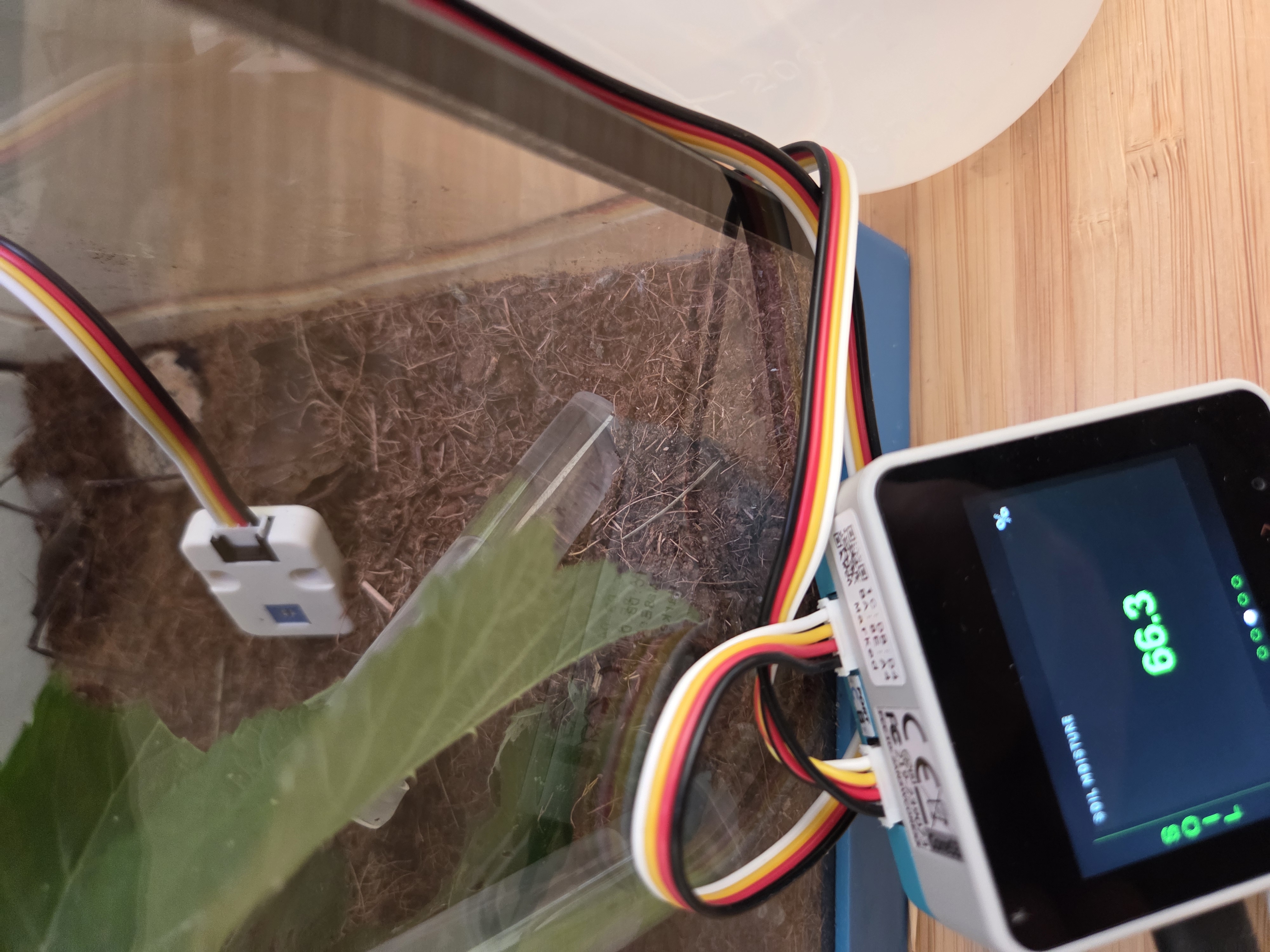
The Phasmida Basic Bundle uses a multi-probe architecture over I2C, the same bus that already handles the ENV III sensor stack. At boot and continuously at runtime, the module scans the bus for connected probes. When it finds one, it adds a dedicated screen to the on-device carousel automatically. When you disconnect one, that screen disappears. No reboot. No configuration. No menu to navigate.
Plug the soil sensor in through the Grove connector and within seconds the touchscreen shows a new card: substrate moisture, live. The same event that updates the local UI fires a probe-connected event upstream over MQTT, so the Smart Portal registers the new probe and adds it to the device's live view without any action on your end.
This is what hot-plug means in practice: the system figures it out and adapts, and you just watch it happen.
Live in the Smart Portal
Once the probe is connected and the device has synced, the soil moisture reading appears in the portal alongside temperature, humidity, and pressure. It trends with the same time resolution as the rest of the telemetry — one reading per cycle, every thirty seconds by default, continuously logged.
That trend line is where most of the value lives. A single number tells you the current state. A week of readings tells you how your substrate actually behaves: how quickly it dries after misting, whether humidity cycles are reaching the floor layer or staying near the surface, whether one corner of the enclosure is consistently wetter than another. Those patterns are invisible when you are looking at the substrate with your eyes. They are obvious when you are looking at a trend line.
Alerts work here too. If you have already configured threshold-based notifications in Smart Cloud, you can add moisture boundaries the same way you would for temperature or humidity. Too dry for three hours — you get a notification. Too wet after a heavy misting — you see it in the data before it becomes a mold problem.
Where to place it
Placement matters more than people expect. A substrate moisture reading from the center of the enclosure is a different thing from a reading near the drainage layer, and both are different from a reading just below the surface where the animals spend most of their time.
The right placement depends on what you want to know. For general husbandry — are the conditions stable, is the substrate maintaining moisture between misting sessions — the center of the active substrate layer is a good default. Push the tines in far enough that they are fully surrounded by material, not resting against the glass or a drainage partition. For species where substrate moisture is particularly critical, some keepers run the sensor mid-depth and use the portal trend to time their misting schedule directly rather than working from habit or guesswork.
The sensor sits flush in the substrate with only the short stem and Grove cable visible. It does not disturb the surface, does not take up enclosure space in any meaningful way, and does not interact with the animals.
The complete picture
The Phasmida Basic Bundle already gives you air: temperature, humidity, pressure, logged and trended continuously. The Soil Moisture Sensor adds ground. Together they close the feedback loop that most keepers are trying to manage by feel — the relationship between what is happening in the air and what is happening in the substrate below.
That relationship is not always obvious. An enclosure can read stable humidity at sensor height while the substrate below is quietly drying out after two days without misting. It can read high humidity after a heavy session while the deep layers are still bone dry because the water did not penetrate. The two readings together tell a story that neither one tells alone.
The sensor costs eleven euros and connects to a system you already own. It takes about thirty seconds to plug in. The screen updates before you put your phone back in your pocket.
That is the add-on. One probe, one cable, one more dimension of data — and a substrate that finally has a voice in the conversation.